

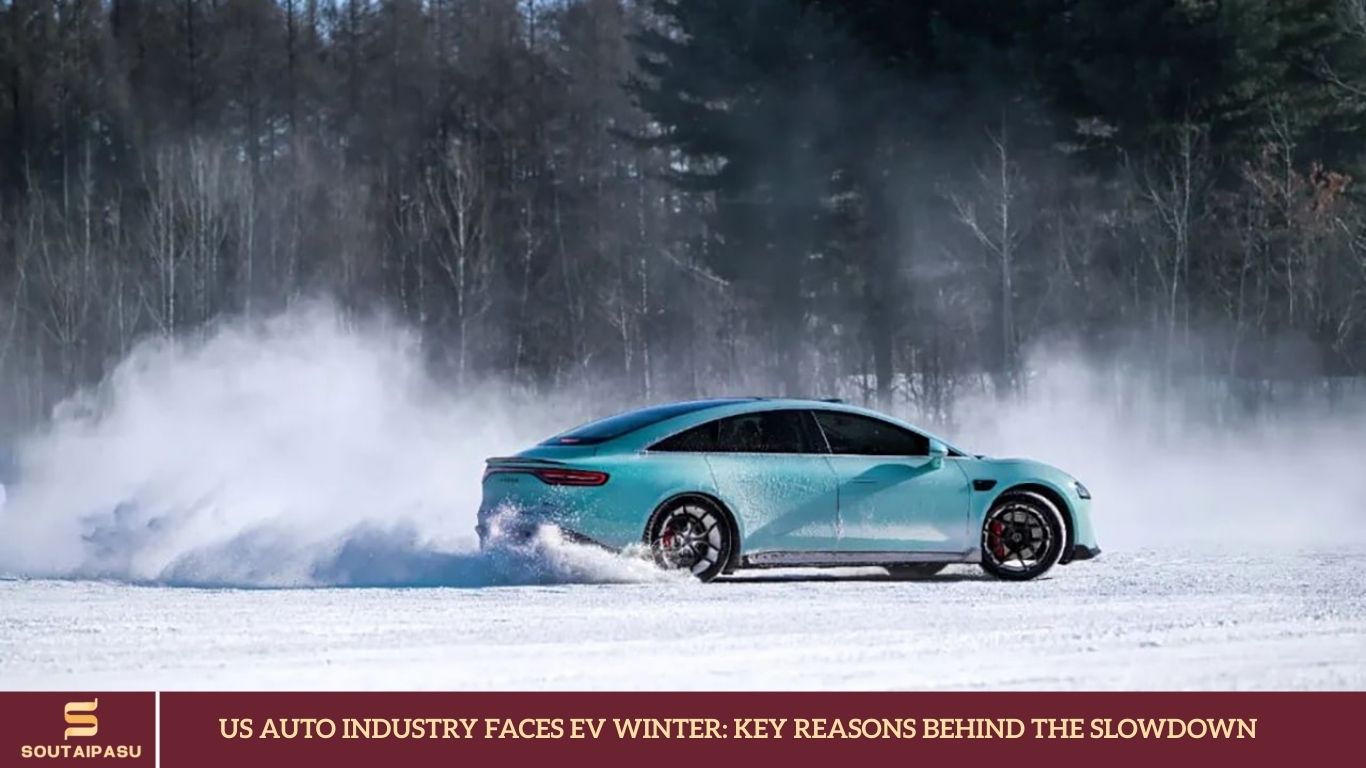
The US electric vehicle (EV) industry, once the shining beacon of automotive innovation, is now facing a challenging “EV winter.” A combination of policy shifts, supply chain disruptions, and market realities is slowing the momentum of EV adoption. For automakers and consumers alike, the landscape is shifting, forcing a rethink of strategies, production priorities, and investment plans.
Why the US EV Market is Cooling
Several factors are contributing to the slowdown in the US EV market. First, government incentives that fueled early growth, like the $7,500 federal tax credit, have ended. This policy shift has led to an immediate drop in consumer demand, as buyers rush to take advantage of remaining incentives. In fact, after a record September in EV purchases, October sales plummeted nearly 49%, according to Cox Automotive data.
Ford CEO Jim Farley warned that EV market share in the US could fall to around 5% in the short term without federal support, while Tesla CEO Elon Musk predicted “a rough few quarters” as subsidies dwindled. These statements reflect a broader industry concern: the US market risks stagnation without affordable, widespread EV options.
US EV Market Faces ‘Perfect Storm’ as Industry Braces for Tough Times
Electric vehicles in the US are confronting a perfect storm that threatens to put the industry on ice. A volatile mix of policy shifts, tariffs, and supply chain disruptions has forced automakers once ambitious about EV production to rethink strategies, cut jobs, and pivot back to hybrids and gasoline-powered vehicles.
CEOs Raise the Alarm
Industry leaders have been sounding warnings for months. The end of the $7,500 federal tax credit in September prompted Ford CEO Jim Farley to predict that EV market share in the US could nearly halve to around 5% in the near term. Meanwhile, Tesla CEO Elon Musk cautioned in July that the company could face a “rough few quarters” as federal support for electric vehicles diminished.
Early data appear to validate their concerns. Following a record surge in September as buyers rushed to claim the tax credit, EV sales plunged nearly 49% in October, according to Cox Automotive.
Stephanie Valdez Streaty, director of industry insights at Cox Automotive, told Business Insider that the rollback of government incentives would “shift the timeline” for EV adoption. She now estimates that EVs will account for roughly 24% of new car sales by 2030 well short of the Biden administration’s goal of 50%.
“We’re not going to see huge growth in the next couple of years,” Valdez Streaty said, highlighting that the lack of affordable EVs remains the biggest barrier to widespread adoption.
A Perfect Storm for Automakers
With demand slowing, carmakers are tightening belts. GM recently announced 1,750 layoffs and took a $1.6 billion charge due to changes in its EV strategy. Rivian followed suit, cutting 4.5% of its workforce.
Global challenges including US tariffs, chip shortages, and a fire at a major Ford aluminum supplier have compounded the problem. “The combination of factors we’re seeing is causing some automakers to delay or cancel EV programs,” said Stephanie Brinley, associate director at S&P Global, warning that consumers will face fewer EV options in the near term.
Some automakers are already pulling EVs from the US market. Nissan stopped selling its Ariya SUV, Honda cut the Acura ZDX, Jeep paused planned EV models, Ram canceled the all-electric Ram 1500 REV, and Ford is reportedly considering shelving its F-150 Lightning.
Doubling Down on Gas and Hybrids
Under pressure, some companies are returning to tried-and-true strategies: hybrids and combustion engines. Toyota committed nearly $1 billion to boost hybrid production in the US, and GM announced plans for new gas-powered vehicles as part of a $4 billion manufacturing overhaul.
Regulatory changes under the Trump administration have also eased restrictions on combustion vehicles, allowing automakers to sell them for longer without facing steep fines for missing EV quotas.
Ford CFO Sherry House noted at a Barclays tech conference that the US EV market is likely to contract, with the company leaning into gas-powered “passion products” like the Mustang and Raptor lines.
Tesla: Weathering the EV Winter
Tesla appears more confident. Despite Musk’s earlier warnings, the company has positioned itself to withstand the downturn, citing AI and robotaxi initiatives as future growth drivers. Tesla’s October deliveries fell 35.3% month-over-month better than the overall 50% industry drop. The company also introduced lower-priced versions of its top models after losing the federal tax credit.
However, Tesla hasn’t launched a new vehicle since the Cybertruck in 2023, focusing instead on its Optimus robot and Cybercab robotaxi projects, both slated for mass production next year. Brinley noted that Tesla’s revenue strategy may be shifting away from conventional EVs toward robotic and autonomous technology.
Other automakers are attempting to fill the affordable EV gap. GM recently launched a new Chevy Bolt starting under $30,000, and Ford is planning an electric truck at a similar price in 2027. Valdez Streaty stressed that EVs still cost roughly $10,000 more than gas-powered counterparts on average, making affordability key to wider adoption in the US.
Without accessible options, the US risks falling behind China, where companies like BYD dominate the EV market, now accounting for more than half of new car sales. “The world’s going electric, and Chinese players continue to innovate with affordable, high-tech vehicles,” Valdez Streaty said. “Delays in US EV adoption could leave the country further behind.”
Supply Chain Disruptions and Tariffs
Another major factor behind the slowdown is supply chain disruption. Automakers have struggled with chip shortages, factory fires, and the lingering effects of US tariffs, all of which have increased costs and delayed production. Ford, for instance, faced a fire at a key aluminum supplier, impacting EV production timelines.
The combination of these challenges has forced some companies to delay or cancel EV programs entirely. Nissan halted sales of its Ariya SUV in the US, Honda cut the Acura ZDX, Jeep postponed certain EV models, and Ram canceled the all-electric Ram 1500 REV. Ford is reportedly reconsidering its flagship F-150 Lightning. These moves underscore how external pressures are directly shaping the US EV market.
Automakers Shift Back to Hybrids and Gas-Powered Vehicles
In response to market pressures, several automakers are returning to hybrid and gasoline-powered vehicles. Toyota announced nearly $1 billion in US investment to boost hybrid production, while GM revealed plans for multiple new gas-powered models as part of a $4 billion manufacturing overhaul.
Regulatory changes under previous administrations have also eased restrictions on combustion vehicles, allowing automakers to continue selling them without facing penalties for missing EV quotas. This shift is a strategic response to slowing EV adoption and changing consumer preferences.
The Affordable EV Gap
One of the most critical factors slowing EV adoption is cost. On average, EVs are still around $10,000 more expensive than comparable gas-powered vehicles. Without more affordable models, EVs remain out of reach for a significant portion of the US car-buying population.
Companies like GM and Ford are attempting to bridge this gap. GM recently launched a new Chevy Bolt starting under $30,000, while Ford teased an electric truck at a similar price point for 2027. Analysts emphasize that making EVs more affordable is key to overcoming the current slowdown and reaching mainstream adoption.
Tesla’s Strategy in the EV Winter
Tesla appears better positioned to weather the current EV winter than many of its competitors. Despite the October drop in sales, Tesla’s deliveries fell only 35.3% month over month less than the overall market decline of nearly 50%.
Tesla’s CEO, Elon Musk, has shifted focus from traditional EV expansion to AI and robotaxi initiatives, which he believes will drive future demand. While the company has not launched a new vehicle since the Cybertruck in 2023, Tesla is preparing to mass-produce the Optimus robot and Cybercab robotaxi next year. Analysts suggest this strategic pivot could reduce Tesla’s reliance on conventional EV sales in the long term.
Consumer Choice and Market Implications
The slowdown in EV adoption has real implications for US consumers. With fewer affordable EV options and some models being pulled from the market, consumers face limited choices. This may slow the overall transition to electric mobility and reduce competition among automakers.
The delay in domestic EV growth also opens opportunities for international players, particularly from China. Companies like BYD dominate the Chinese EV market, where more than half of new car sales are electric, and are now expanding rapidly into global markets. Industry experts warn that the US risks falling behind if affordable EV options are not widely available.
Frequently Asked Questions
Why is the US EV market slowing down?
The US EV market is slowing due to a combination of factors, including the end of the $7,500 federal tax credit, rising vehicle costs, supply chain disruptions, and shifting consumer preferences toward hybrids and gas-powered vehicles.
How have automakers responded to the EV slowdown?
Automakers like GM, Ford, and Rivian are revising EV strategies, laying off workers, and investing more in hybrid and gasoline vehicles to maintain revenue while EV demand cools.
What role do supply chain issues play in the EV winter?
Supply chain disruptions, such as chip shortages, factory fires, and tariffs, have delayed EV production, increased costs, and forced some companies to cancel or postpone electric vehicle programs.
How is Tesla managing the EV slowdown?
Tesla has weathered the downturn better than its competitors by introducing lower-priced models and focusing on future technologies like AI-driven robotaxis and the Optimus robot, reducing reliance on traditional EV sales.
Why are affordable EVs important for the US market?
EVs remain around $10,000 more expensive than gas-powered cars on average. Affordable options are essential to increase adoption, meet consumer demand, and prevent the US from falling behind global competitors like China.
Could the US lose its edge in the global EV market?
Yes. Delays in EV adoption and limited affordable models could allow Chinese automakers, such as BYD, to dominate the global market, leaving the US auto industry at a competitive disadvantage.
Conclusion
The US auto industry is entering an EV winter, driven by a mix of policy changes, supply chain disruptions, and high vehicle costs. Automakers are responding by adjusting strategies, cutting jobs, and investing in hybrid and gas-powered vehicles, while Tesla focuses on innovation and future technologies. Affordable EV options, supportive policies, and streamlined production will be critical for reigniting demand and keeping the US competitive in the global electric vehicle market. Without these measures, the country risks falling behind international leaders like China in the race toward electrification.